

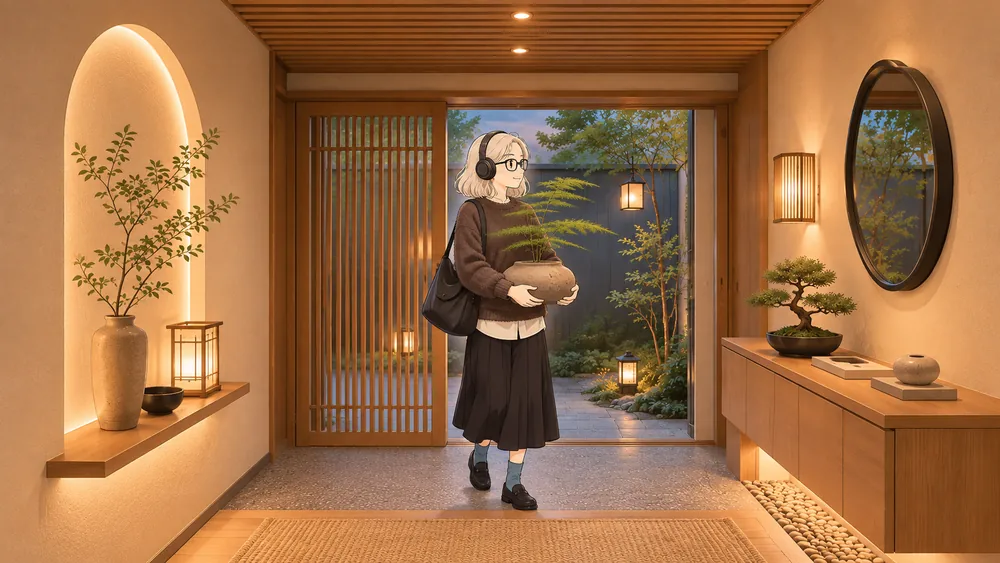
Plants can bring warmth and softness into a room, but even beautiful greenery can start to feel busy when every shelf, table and empty corner is filled.
If you already have houseplants, styling them in a Japandi-inspired home is less about adding more plants and more about deciding where each one actually belongs. The pot, scale, surrounding furniture and empty space all affect whether the room feels calm or crowded.
If you are still choosing greenery for your home, start with our guide to Japandi plants. This article focuses instead on arranging and styling the plants you already have.
Start With Space, Not More Plants
Before moving individual pots around, look at the room as a whole.
An empty section of floor, shelf or wall does not automatically need a plant. Sometimes that open area is what allows the greenery elsewhere in the room to stand out.
It can help to look from the doorway or from the place where you usually sit. Notice where your eye naturally goes and whether several plants are competing for attention in the same area.
Instead of asking, “Where can I fit another plant?”, try asking, “Would greenery improve this part of the room, or is the empty space already doing its job?”
This matters especially in a Japandi-inspired room, where the overall balance matters more than filling every available surface.
Choose Pots That Feel Calm, Not Perfectly Matched
Plant pots do not need to come from the same collection.
A mix of warm white, cream, sand, stone grey, muted brown and earthy tones can still feel cohesive, particularly when some qualities repeat across the room.
Ceramic, stoneware and clay-like finishes can work well because their texture adds interest without relying on busy patterns. Matte or softly textured surfaces can also sit quietly beside wood furniture and simple textiles.
The goal is not to make every pot identical. A room often feels more natural when the pots relate to each other without looking deliberately matched.
Think About Scale as Well as Colour
Colour is only part of the decision.
Look at the relationship between the plant, its pot, the furniture underneath or beside it, and the amount of open space around the whole arrangement.
A very small pot can disappear visually on a wide console. Several small pots can make a narrow shelf feel much fuller than expected. A substantial plant can also make nearby furniture feel crowded if there is not enough room around its leaves.
Scale changes over time too. Plants are living parts of the room rather than fixed decorative objects, so an arrangement that feels proportional today may need adjusting later.
Place Plants Where They Have Room to Be Seen
Different areas of the home need slightly different treatment.
On the floor, larger plants usually need enough surrounding space to read as one clear element rather than something squeezed between furniture.
On shelves and consoles, leave room between the plant and nearby objects. Books, lamps, candles and decorative pieces do not all need to share the same small surface.
On tables and windows, consider how much practical space the plant takes away. A good-looking arrangement should still allow the table, windowsill or work surface to function normally.
An empty corner can still be the wrong corner. Styling should also come after the plant’s real environmental needs; a visually perfect position is not useful if the location itself does not suit the plant.
Balance Height Without Creating a Plant Display
Varying height can help greenery move naturally through a room, but it does not need to become a formal plant display.
A smaller plant might sit on a table, another at shelf height, while a larger plant occupies the floor elsewhere. These differences create rhythm without requiring everything to be arranged together.
A substantial plant beside a large window can often stand on its own without needing shelving or extra decorative objects around it.
The important point is not to create a perfect sequence of low, medium and tall plants. Look at how the greenery is distributed across the whole room instead.
Group Plants Carefully
There is no rule that houseplants must always be grouped in threes.
One plant may be enough when it already has a strong shape or takes up significant visual space. Smaller plants can work together when the surface is large enough and the arrangement still feels readable.
The useful question is whether you can still see each plant clearly, with enough space around it.
Step Back and Edit the Room
When an arrangement feels slightly wrong, adding another pot or decorative object is rarely the only solution.
Try a simple editing process:
- Place the plant.
- Step back and look from a normal viewing point.
- Notice what is competing with it.
- Move or remove something if the area feels crowded.
Check the furniture as well as the plants. A shelf may need one fewer object. A plant may work better on another surface. Two plants that once suited each other may eventually need separate positions.
Small changes can be enough to bring the arrangement back into balance.
Let the Arrangement Change With the Plants
Styling plants in a Japandi home does not require perfectly matching pots or strict decorating formulas.
What matters more is the relationship between the greenery, the furniture and the open space around them.
Give each plant enough visual room to belong, pay attention to scale, and be willing to change the arrangement when something no longer feels balanced.
Sometimes the most useful styling decision is not adding another plant at all. It is noticing that the room already has enough.